
Buying a Residential Plot in Red Hills: Why Should You Check Drainage and Ground Level Before Investing?
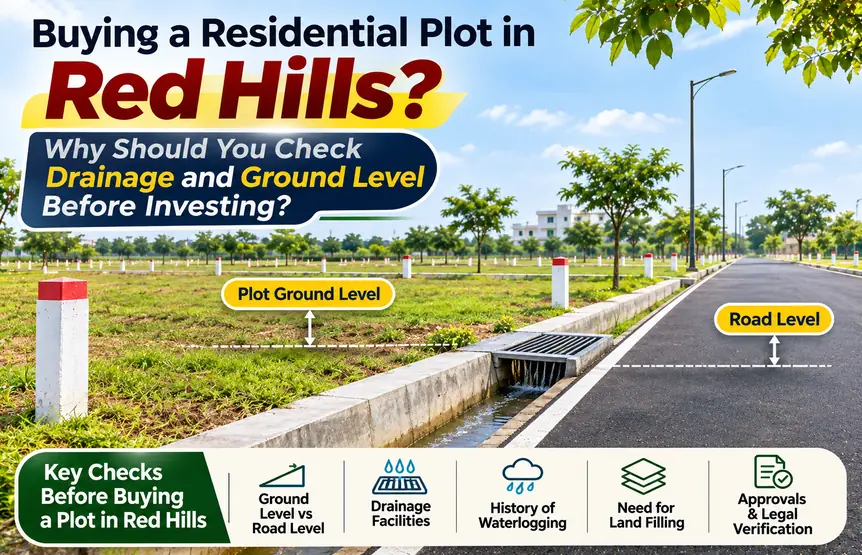
Buying a residential plot is an important decision, especially when you are planning to build your dream home. While most buyers compare plot prices, locations, road connectivity and approvals, two important factors are often overlooked: drainage conditions and ground level.
A residential plot may look attractive during the summer, but what happens when heavy rainfall occurs? Will rainwater flow away naturally, or could it accumulate within the property? Is the plot lower than the surrounding road?
These questions are worth asking before purchasing land.
For buyers exploring residential plots in Red Hills, understanding the property's ground elevation and surrounding drainage arrangements can help avoid unexpected expenses and construction difficulties.
Red Hills, also known as Sengundram, is located in the northern part of the Chennai metropolitan region. The area includes established residential neighbourhoods, developing layouts and important road connections.
However, ground conditions can vary significantly between individual properties.
If you are considering buying land, explore available properties for sale in Red Hills through Chennai Land.
This guide explains how to evaluate drainage, road elevation, waterlogging and land preparation requirements before making a purchase.
Why Are Drainage and Ground Level Important When Buying a Residential Plot?
Drainage refers to how rainwater moves away from a property and its surrounding area.
Ground level refers to the elevation of the plot in relation to nearby roads, buildings and other land.
Both factors influence the practical suitability of a residential site.
A plot with inadequate drainage or unsuitable elevation may require additional engineering work before construction.
Potential concerns include:
-
Rainwater accumulating within the plot.
-
Water entering the property from nearby roads.
-
Poor surface runoff.
-
Difficult access during heavy rainfall.
-
Additional land-filling expenses.
-
Increased foundation or site preparation costs.
-
Waterlogging in surrounding streets.
These conditions do not automatically make a plot unsuitable for purchase.
However, they should be evaluated before finalising the property.
A qualified civil engineer can help determine whether the site requires specific drainage or ground improvement measures.
1. Check Whether the Plot Is Higher or Lower Than the Road
One of the first things buyers should observe during a site visit is the difference between the plot's ground level and the adjoining road.
For example, consider two hypothetical properties.
Plot A: The land is approximately level with the adjoining road.
Plot B: The land is noticeably lower than the road.
During rainfall, surface water may move from higher areas towards lower areas, depending on the terrain and available drainage.
A lower plot may therefore require closer examination of how water enters and leaves the site.
However, a plot being higher than the road does not automatically guarantee that it is protected from flooding.
Water flow also depends on surrounding topography, drainage capacity, rainfall intensity and nearby watercourses.
What Should Buyers Check?
-
Is the plot lower than the adjoining road?
-
Does the road slope towards the property?
-
Is there a drainage channel nearby?
-
Where does rainwater from surrounding plots flow?
-
Are nearby houses built on raised foundations?
-
Is the site connected to a functioning stormwater drainage system?
If the level difference is significant, consult an engineer before estimating land-filling requirements.
2. Understand the Drainage Facilities Around the Plot
Drainage is not only about the individual property.
The surrounding neighbourhood also plays an important role.
A plot may have sufficient elevation, but waterlogging on the access road can still create difficulties during heavy rainfall.
When visiting residential layouts in Red Hills, observe whether the surrounding streets have suitable drainage arrangements.
Important Questions to Ask
Are stormwater drains available?
Check whether drains exist along the roads and whether they appear properly connected to an authorised drainage outlet.
Are the drains blocked?
Look for accumulated waste, vegetation or sediment that may restrict water movement.
Where does the rainwater discharge?
A roadside drain is useful only when the overall drainage arrangement can safely carry water away.
Are the roads properly graded?
Road slopes can influence where surface water accumulates.
Does water enter neighbouring properties?
Visible signs of water movement may help identify potential issues.
Do not assume that a newly developed layout has a fully functioning drainage network simply because roadside channels are visible.
3. Why Should Buyers Visit the Property During or After Rainfall?
A site visit during dry weather may not reveal drainage-related concerns.
Rainfall can provide additional information about how water behaves around a property.
If it is safe and practical, visiting the neighbourhood after rainfall may help buyers observe:
-
Water accumulation on access roads.
-
Standing water inside vacant plots.
-
Overflowing roadside drains.
-
Muddy or inaccessible internal roads.
-
Water entering nearby residential properties.
-
Areas where rainwater takes longer to drain away.
However, a single site visit cannot establish a property's complete flood history.
A location that appears dry after moderate rainfall may still experience problems during unusually heavy rainfall.
Buyers should combine site observations with local enquiries, available flood-related records and professional assessment.
4. Does Buying a Plot Near Red Hills Lake Require Additional Checks?
Red Hills is associated with the Red Hills Lake, also known as Puzhal Lake, an important waterbody in the Chennai region.
However, not every residential plot advertised in Red Hills is located near the lake, and the area's flood exposure cannot be determined from the locality name alone.
Buyers considering properties near lakes, canals, drainage channels or other waterbodies should conduct additional checks.
Verify the Exact Property Location
Identify the survey number and locate the property accurately on relevant official maps and records.
Check Land Classification
Review the applicable revenue and land-use records.
Confirm that the property is not situated on land classified or restricted in a way that prevents the proposed residential use.
Examine Waterbody and Drainage Boundaries
Where relevant, verify whether the plot is affected by a waterbody boundary, drainage corridor, buffer requirement or other legal restriction.
Review Available Flood Information
Consult relevant government flood-risk information and local authority records where available.
Seek Professional Advice
A property lawyer, surveyor and qualified engineer can help assess different aspects of the site.
Proximity to a lake does not automatically establish that a plot is flood-prone, but it makes accurate location and regulatory verification particularly important.
5. How Can You Identify Signs of Previous Waterlogging?
Some physical conditions may indicate that a property or surrounding area has experienced standing water.
These signs should be treated as reasons for further investigation rather than conclusive evidence.
Water Marks on Nearby Walls
Staining or discolouration may suggest previous exposure to moisture.
However, such marks can also have other causes.
Sediment Deposits
Mud or fine sediment left on surfaces may indicate previous water movement.
Uneven or Recently Filled Ground
A property with noticeably different soil levels may have undergone site preparation.
Ask the seller about any filling work and request supporting information.
Damaged Internal Roads
Repeated deterioration may justify further investigation into drainage, traffic loads and road construction quality.
Standing Water in Adjacent Vacant Plots
Observe whether neighbouring properties contain stagnant water after rainfall.
Information from Nearby Residents
Speak with people who live or work in the area.
Ask whether the road becomes difficult to use during heavy rainfall and whether water has previously entered nearby properties.
Local observations are useful, but they should be checked against other evidence where possible.
6. What Is Land Filling, and When Might It Be Necessary?
Land filling involves adding suitable material to raise or improve the ground level of a site.
Some residential plots may require filling as part of their preparation for construction.
However, not every low-lying plot should simply be raised with soil.
The need for filling depends on site levels, drainage patterns, soil conditions and the proposed building.
Why Might Land Filling Be Considered?
-
To achieve an appropriate site formation level.
-
To support an engineered drainage arrangement.
-
To prepare the site for planned construction.
-
To address specific ground conditions identified by professionals.
What Should Buyers Verify?
Before undertaking filling work, consult a qualified engineer.
The assessment may need to consider:
-
Existing ground elevation.
-
Proposed finished ground level.
-
Soil type and bearing conditions.
-
Compaction requirements.
-
Drainage arrangements.
-
Impact on neighbouring properties.
-
Applicable local regulations.
Unplanned filling can redirect rainwater towards neighbouring land or create other drainage problems.
It may also fail to address deeper soil or groundwater-related issues.
7. How Much Can Plot Ground Preparation Cost?
Ground preparation expenses depend on the individual property.
Factors influencing the cost may include:
-
Total plot area.
-
Required filling depth.
-
Type and quantity of suitable material.
-
Transportation distance.
-
Site accessibility.
-
Compaction requirements.
-
Drainage work.
-
Soil testing and engineering recommendations.
For example, a hypothetical 1,000 sq. ft. plot requiring an average filling depth of 1 foot would involve approximately 1,000 cubic feet of geometric fill volume before allowances for compaction and other requirements.
This is only a volume calculation, not a recommendation to fill the plot.
The actual material quantity and work required must be determined through professional site assessment.
Buyers should obtain a written estimate from a qualified contractor or engineer before including site preparation expenses in their purchase budget.
8. Why Does Soil Condition Matter Along with Ground Level?
Ground elevation and drainage are important, but they do not provide a complete picture of construction suitability.
The soil beneath a residential plot also affects foundation planning.
Different soil conditions may require different engineering approaches.
For example, site investigations may identify:
-
Loose or poorly compacted fill.
-
Soft soil layers.
-
Expansive soil.
-
High groundwater levels.
-
Variations in soil-bearing capacity.
These conditions cannot be reliably assessed through visual inspection alone.
A geotechnical investigation may be appropriate depending on the proposed building and site conditions.
Before constructing a home, consult a qualified structural engineer or geotechnical professional regarding the required investigations.
9. Can a Raised Plot Still Experience Waterlogging?
Yes.
A raised plot may still face drainage-related problems under certain conditions.
For example:
-
Surrounding roads may become waterlogged.
-
Stormwater drains may be blocked.
-
Rainfall may exceed drainage capacity.
-
Water may accumulate within enclosed areas.
-
Nearby drainage channels may overflow.
-
Surface grading may direct water towards the building.
This is why ground elevation should never be evaluated in isolation.
The complete drainage arrangement, surrounding terrain and relevant flood information should be considered.
10. What Should You Check About Road Access During the Rainy Season?
Road connectivity is an important factor for buyers planning to build a house.
However, access should be evaluated under different weather conditions.
A road that appears convenient during dry weather may become difficult to use after heavy rainfall.
Important Road-Related Checks
Road surface
Observe whether the road is paved, damaged or uneven.
Road elevation
Check whether the road has low sections where water may accumulate.
Drainage
Look for functional drainage arrangements along the road.
Legal access
Verify that the property has legally recognised road access.
Construction vehicle access
Consider whether vehicles carrying building materials can reach the site.
Connectivity to main roads
Evaluate the condition of the routes connecting the plot to nearby main roads.
These checks can help buyers assess the practical accessibility of residential plots in Red Hills.
11. Should You Choose a Higher Plot or a Lower-Priced Plot That Needs Filling?
Buyers may sometimes compare two properties with different ground conditions.
For example:
Plot A: Higher asking price, with a site level that appears suitable for the intended development.
Plot B: Lower asking price, but with a noticeable difference between the plot and road levels.
The lower-priced plot may initially appear more affordable.
However, the overall comparison should include any necessary engineering and site preparation work.
| Comparison factor | Plot A | Plot B |
|---|---|---|
| Basic land price | Higher | Lower |
| Ground level | Requires verification | Requires verification |
| Potential filling work | Depends on assessment | May need additional assessment |
| Drainage suitability | Must be checked | Must be checked |
| Soil conditions | Must be tested where necessary | Must be tested where necessary |
| Overall purchase suitability | Depends on total findings | Depends on total findings |
Neither option can be considered better without examining the actual properties.
A lower asking price may not result in a lower total cost if substantial site preparation is required.
Similarly, a higher plot is not automatically free from drainage or construction concerns.
12. What Legal Documents Should You Verify Before Buying a Plot in Red Hills?
Drainage and elevation checks should be combined with proper legal verification.
Important documents may include:
Sale Deed and Parent Documents
Review the ownership records and relevant chain of title.
Encumbrance Certificate
Examine registered transactions and encumbrances for the appropriate period.
Patta and Revenue Records
Verify the relevant land classification, survey details and recorded information.
Layout Approval
Confirm the applicable CMDA, DTCP or other authorised planning approval, depending on the property's jurisdiction and approval framework.
Survey and Boundary Records
Ensure that the physical property corresponds to the relevant documents.
Road Access Records
Confirm that the plot has lawful access.
Applicable Land-Use Restrictions
Where relevant, verify restrictions relating to waterbodies, drainage corridors or other regulated areas.
Planning approval does not independently guarantee clear ownership or establish that a site is free from drainage-related problems.
Engage an independent property lawyer to review the relevant documents before purchasing.
13. How to Compare Residential Plots in Red Hills Before Investing
Buyers should evaluate multiple factors rather than choosing a property solely on price.
A practical comparison may include:
Location: Consider access to workplaces, schools, hospitals and other essential destinations.
Plot dimensions: Check the area, frontage, depth and shape.
Road connectivity: Evaluate legal access and the condition of nearby roads.
Drainage: Review stormwater arrangements and surrounding water flow.
Ground elevation: Compare plot levels with roads and neighbouring properties.
Soil conditions: Obtain appropriate engineering advice.
Legal status: Verify ownership, land classification and planning approvals.
Total cost: Include registration, professional fees and any necessary site preparation.
To begin comparing available options, explore residential plots for sale in Red Hills through Chennai Land.
14. A Practical Site Inspection Checklist for Red Hills Plot Buyers
Before finalising a residential plot, use the following checklist:
-
Check the plot's elevation relative to the road.
-
Observe the slope of surrounding land.
-
Identify nearby stormwater drains.
-
Confirm where surface water can discharge.
-
Inspect roads after rainfall where possible.
-
Ask nearby residents about previous waterlogging.
-
Review available flood-related information.
-
Verify land classification and applicable restrictions.
-
Check the condition of neighbouring plots.
-
Obtain professional advice on soil and site preparation.
-
Confirm the relevant layout approval.
-
Verify ownership and legal road access.
-
Estimate the total purchase and development cost.
A detailed inspection can help buyers identify concerns that may not be visible in property advertisements.
15. Explore Residential Plots for Sale in Red Hills with Chennai Land
Finding the right residential plot involves more than comparing prices and locations.
Buyers should also understand the physical condition of the land and its suitability for future construction.
Chennai Land helps property seekers explore residential plots and other property options across Chennai and its surrounding areas.
If you are considering purchasing land in Red Hills, browse available properties for sale in Red Hills.
Compare advertised plot sizes, locations and project details before arranging site visits.
Property availability and prices may change, so confirm the latest information before proceeding.
Always independently verify the legal documents, planning approvals, drainage conditions and construction suitability of a shortlisted property.
Final Thoughts
Buying a residential plot in Red Hills requires careful evaluation of both legal documentation and physical site conditions.
Drainage and ground elevation are particularly important because they can affect access, construction planning and overall development expenses.
A plot that looks attractive during dry weather may require additional investigation to understand how rainwater behaves during heavy rainfall.
Before purchasing, compare the property's elevation with surrounding roads, inspect drainage arrangements, review available flood information and obtain professional advice where necessary.
The best residential plot is not necessarily the cheapest or the highest. It is one that meets your requirements after proper legal, technical and financial evaluation.
Explore suitable residential plots in Red Hills, compare your options and make an informed property decision with Chennai Land.