
What Should Buyers Verify About Dedicated Parking Allotment in Apartments in Tambaram East?
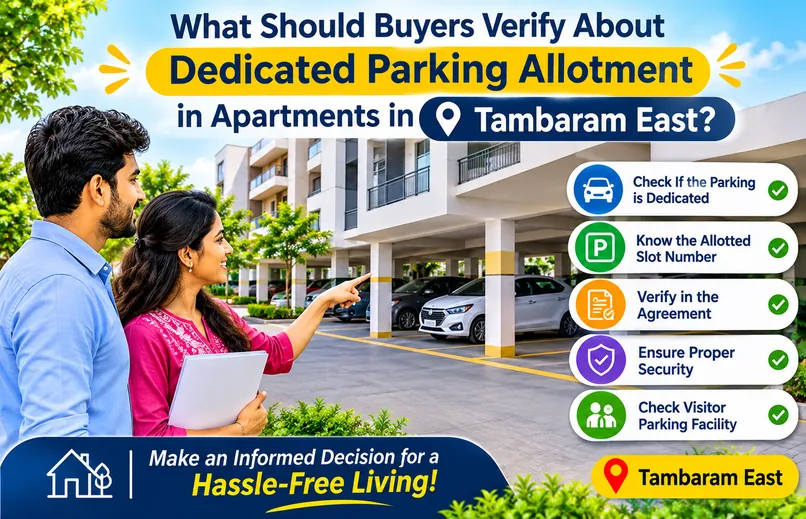
Buying an apartment involves more than comparing the floor area, location and total purchase price. Parking availability is another important consideration, particularly for families who own cars or plan to purchase a vehicle in the future.
Apartment developments may offer different parking arrangements, including covered parking, stilt parking, basement parking and open parking. However, the availability of a parking space does not automatically mean that it is independently owned or legally allotted to an individual apartment.
Before booking a flat, buyers should understand how parking spaces are allocated, what the sale agreement specifies and whether the proposed arrangement complies with applicable regulations.
If you are exploring apartments for sale in Tambaram East, this guide explains the important parking-related checks to complete before making a purchase decision.
1. Understand the Difference Between Dedicated and Common Parking
One of the first things buyers should understand is the difference between a dedicated parking allocation and common parking facilities.
A dedicated parking arrangement generally refers to a parking space identified for the use of a particular apartment, subject to applicable legal provisions and project documentation.
Common parking areas, on the other hand, are shared facilities intended for use according to the apartment association's rules and applicable regulations.
Before booking, ask the builder:
-
Is a parking space specifically identified for the apartment?
-
Is the parking arrangement included in the apartment's purchase terms?
-
Is the space designated for exclusive use or shared use?
-
How is parking allocation documented?
-
Are there any restrictions on vehicle types or sizes?
Buyers should not assume that a parking space is independently owned simply because the builder describes it as dedicated parking.
2. Check the Type of Parking Provided
Apartment developments may offer different parking arrangements depending on the building design and available land.
Covered Parking
Covered parking provides protection from direct sunlight and rainfall. Buyers should inspect the roof coverage, available space, access and ventilation.
Stilt Parking
Stilt parking is generally provided at the ground level beneath the elevated residential floors. Check the entrance height, column positions, turning space and movement within the parking area.
Basement Parking
Basement parking uses designated areas below ground level. Buyers should inspect ramp access, ventilation, lighting, drainage and water protection arrangements.
Open Parking
Open parking is provided in designated outdoor areas. Check whether the parking location is clearly marked and whether it offers convenient access to the apartment entrance.
The actual parking arrangement should be verified against the approved building plan and relevant project documents.
3. Verify the Parking Space in the Approved Building Plan
A brochure or sample apartment illustration may show parking facilities, but buyers should examine the relevant approved building plan.
The plan can help identify the parking areas and understand how vehicles move within the premises.
Check the following:
-
Whether parking areas are shown in the approved plan.
-
The number of parking spaces provided.
-
Vehicle entry and exit locations.
-
Ramp positions in basement parking.
-
Internal vehicle movement arrangements.
-
Locations of columns and structural elements.
-
Whether parking areas are marked as common or designated facilities.
If the builder promises a specific parking arrangement, ask for written clarification and supporting documents before paying the booking amount.
4. Check the Parking Space Dimensions
A parking space may be available but still be inconvenient if its dimensions are unsuitable for the buyer's vehicle.
Before accepting a parking allocation, consider the following:
-
Length and width of the parking space.
-
Clearance around the vehicle.
-
Space required to open vehicle doors.
-
Distance from nearby columns and walls.
-
Turning space for entering and exiting.
-
Access to the apartment entrance.
-
Height restrictions, particularly in basement and stilt parking.
Buyers who own larger vehicles should physically inspect the parking space rather than relying only on a verbal assurance.
It is also useful to check whether the parking arrangement can accommodate a future vehicle change.
5. Understand Parking Allotment and Legal Rights
Parking rights in apartment developments should be understood carefully.
In Nahalchand Laloochand Pvt. Ltd. v. Panchali Cooperative Housing Society Ltd., the Supreme Court considered the treatment of open and stilt parking spaces under the Maharashtra Ownership Flats Act and held that such spaces formed part of common areas rather than independently saleable premises under that legislation.
For properties in Tamil Nadu, buyers should consider the applicable provisions of the Tamil Nadu Apartment Ownership Act, 2022, relevant rules and project-specific legal documents.
Before purchasing, clarify:
-
Whether the parking area is classified as a common area.
-
Whether a specific parking space is allocated for the apartment's use.
-
Whether the allocation is documented in the sale agreement.
-
Whether the builder is charging a separate parking fee.
-
Whether the proposed arrangement complies with applicable law.
A property lawyer should review the parking-related clauses before the buyer signs the agreement.
6. Verify Parking Details in the Sale Agreement
Verbal assurances about parking should not replace written documentation.
Buyers should review the agreement for sale and other relevant project documents to understand the parking arrangement.
Look for:
-
Description of the parking facility.
-
Type of parking provided.
-
Parking space identification, where applicable.
-
Allocation or usage conditions.
-
Any additional charges.
-
Maintenance responsibilities.
-
Restrictions on vehicle access.
-
References to common areas and shared facilities.
If the builder has promised a specific parking space, ask for the relevant written confirmation and ensure it is consistent with the approved plan and applicable legal requirements.
7. Check Visitor Parking Availability
Dedicated resident parking does not necessarily mean the apartment complex has sufficient visitor parking.
This can become a practical concern for families who regularly receive guests, relatives or service providers.
During your site visit, check:
-
Whether visitor parking is provided.
-
How visitor vehicles enter the premises.
-
Whether visitor spaces are clearly identified.
-
Whether visitors are permitted to use unoccupied common parking areas.
-
Whether there are time restrictions.
-
Whether visitor parking affects resident vehicle movement.
Understanding these arrangements can help buyers evaluate the overall convenience of the apartment community.
8. Inspect Vehicle Entry and Exit Facilities
Parking convenience depends not only on the allocated space but also on the accessibility of the entire parking area.
Check the vehicle entrance and exit during your site visit.
Important factors include:
-
Width of the entry and exit gates.
-
Turning radius near the entrance.
-
Ramp slope in basement parking.
-
Visibility while entering and leaving.
-
Space for two-way vehicle movement, where provided.
-
Security arrangements at vehicle access points.
-
Clearance for larger cars and SUVs.
If possible, request permission to test vehicle access using a similar-sized car.
9. Understand Parking Maintenance Responsibilities
Parking facilities require regular maintenance to remain safe and usable.
Buyers should understand how the apartment association or building management will maintain these areas.
Ask about:
-
Cleaning of parking floors.
-
Lighting and electrical maintenance.
-
Basement ventilation.
-
Drainage and water removal.
-
Security camera coverage.
-
Fire safety provisions.
-
Maintenance charges.
-
Responsibility for repairing damaged parking surfaces.
These details are particularly important in larger apartment developments where several residents share common parking facilities.
10. Common Parking-Related Mistakes Apartment Buyers Should Avoid
Buyers should avoid making assumptions about parking based solely on promotional materials.
| Common mistake | What buyers should do |
|---|---|
| Assuming parking is independently owned | Verify the legal classification and allotment conditions |
| Relying only on verbal promises | Obtain written confirmation |
| Ignoring parking dimensions | Measure the space and inspect vehicle access |
| Not checking the approved plan | Compare actual facilities with approved documents |
| Overlooking visitor parking | Understand the project's visitor arrangements |
| Ignoring maintenance responsibilities | Review association and maintenance provisions |
| Paying additional parking charges without clarification | Ask for a written cost breakdown and legal basis |
Taking time to verify these details can help buyers avoid misunderstandings after purchasing an apartment.
11. Documents and Details to Review Before Booking
Before finalising an apartment in Tambaram East, buyers should review the following documents and details:
-
Approved building plan showing the parking arrangements.
-
Agreement for sale and its parking-related clauses.
-
Relevant project and common-area documents.
-
Parking allocation or usage confirmation, where applicable.
-
Details of additional parking charges, if any.
-
Maintenance and association rules.
-
Applicable project approvals and RERA details, where required.
Buyers should obtain clarification whenever the documents and the builder's verbal assurances differ. Independent legal verification is advisable before signing the agreement or making additional payments.
Conclusion
Parking arrangements are an important part of apartment selection, particularly for buyers who own vehicles or expect to purchase one in the future. Understanding the type of parking, available dimensions, access facilities, legal rights and maintenance responsibilities can help buyers make better-informed decisions.
Before booking an apartment in Tambaram East, inspect the parking area, review the approved building plan and carefully examine the agreement for sale. Do not rely solely on verbal promises or brochure illustrations.
If you are planning to purchase an apartment, explore the latest properties for sale in Tambaram East on ChennaiLand. Compare available residential options and review the important property details before choosing your next home.